· Business
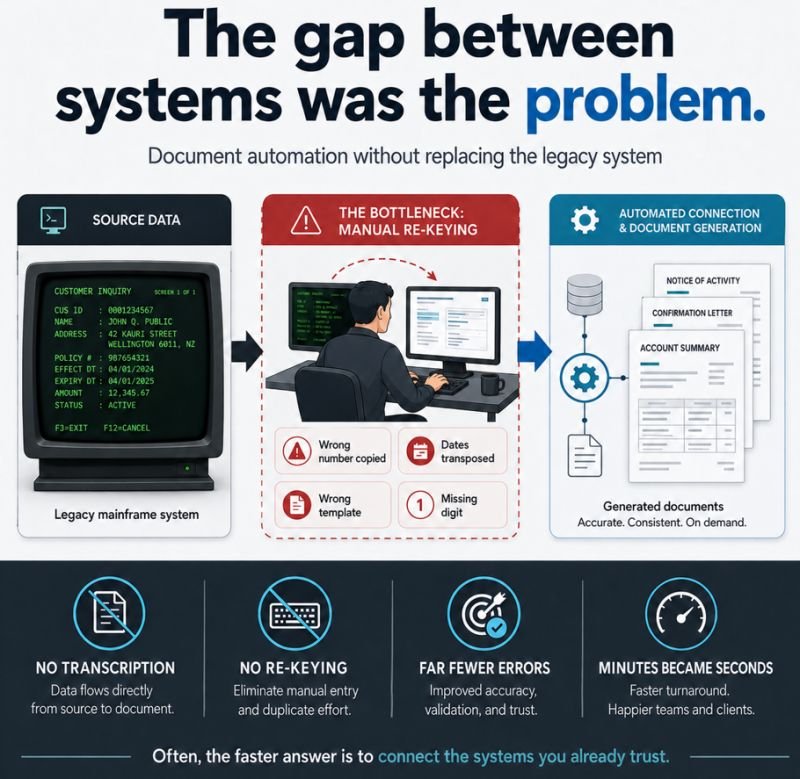
Between them sat a person reading from a screen and typing into approved templates.
Most days, it worked. Some days:
- Wrong number copied.
- Dates transposed.
- Wrong template selected.
- A reference number with a missing digit.
Some errors got caught at the next step. Some made it to the customer.
The result was rework, checking, customer issues, compliance exposure, and 10–20 minutes of careful re-keying per document.
The mainframe was not the problem. The Word templates were not the problem. The gap between them was the problem.
So we connected them. A simple service to automate document generation from the source data.
- No transcription.
- No re-keying.
- Far fewer errors.
- Minutes became seconds.
This was not a process problem. It was an integration problem.
A lot of automation projects start by replacing systems. Often, the faster answer is to connect the systems you already trust.