“Not every problem should be solved with AI — especially in finance.” AI promises efficiency, but in regulated industries, unverified...
🧠 AI Risk in Regulated Environments
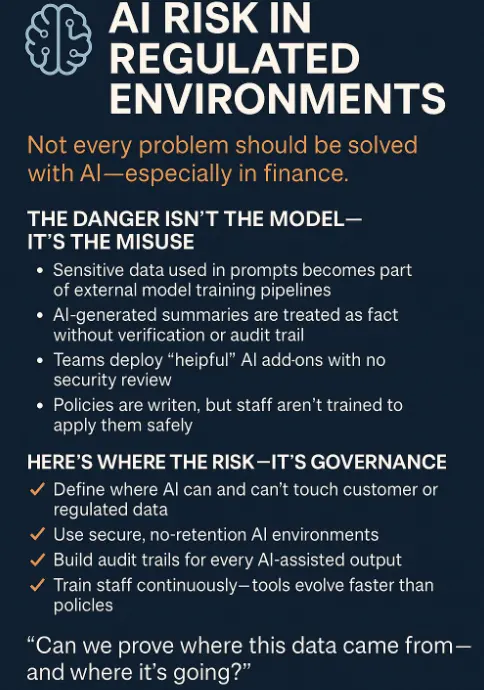
“Not every problem should be solved with AI — especially in finance.”
AI promises efficiency, but in regulated industries, unverified use can quietly open compliance gaps you can’t close later.
💥 The danger isn’t the AI tools — it’s how people use them
When staff paste client data into public tools or use AI-generated output without validation, you’re no longer just automating; you’re potentially breaching confidentiality, misrepresenting facts or leaking regulated data into external training sets.
⚠️ If your AI policy is “we don’t have one yet,” you already have exposure
🔍 Here’s where the risk creeps in:
• Sensitive data used in prompts becomes part of external model training pipelines.
• AI-generated summaries are treated as fact without verification or an audit trail.
• Teams deploy “helpful” AI add-ons with no security review.
• Policies are written, but staff aren’t trained to apply them safely.
💡 The solution isn’t fear — it’s governance
✅ Define where AI can and can’t touch customer or regulated data.
✅ Use secure, no-retention AI environments.
✅ Build audit trails for every AI-assisted output.
✅ Train staff continuously; tools evolve faster than policies.
AI can strengthen compliance if deployed responsibly.
But without guardrails, it turns your best people into accidental risk.
Before rolling out AI in any financial workflow, ask:
“Can we prove where this data came from and where it’s going?”